Aircon gas top-up and leaks: what is normal and what to ask
By Jacky Lee, Editor · Updated 2026-10-25
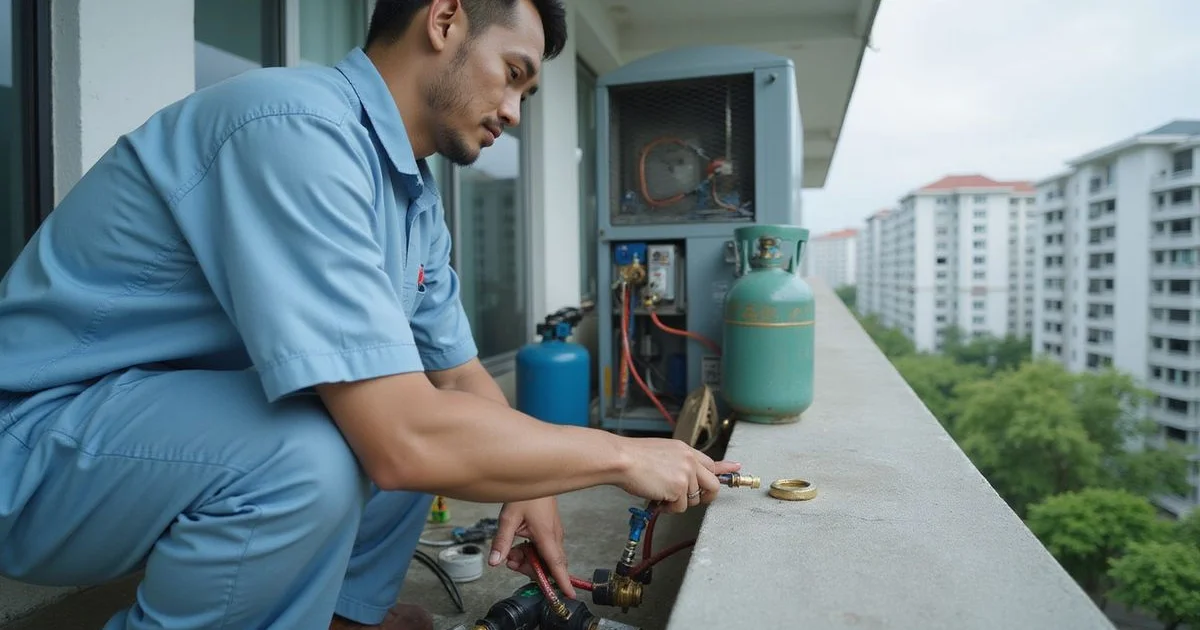
“Your aircon needs a gas top-up” is one of the most common things a technician says, and one of the least explained. Most people nod and pay. This guide gives you the context to ask better questions.
Providers who handle this work are grouped under the gas top-up and leak repair category, and demand for gas topics is steady in local searches.
Why gas gets low
An air conditioner’s refrigerant circuit is sealed. Refrigerant is not consumed like fuel. If the level is low, refrigerant has escaped somewhere. That can be a loose flare connection, a worn joint on the piping, or a pinhole in a coil.
This is why the glossary describes a top-up as adding a small amount to a unit that has lost gas, and why repeated top-ups on the same unit deserve a question: where is it going?
Signs of low refrigerant
- The unit runs but air from the vents is not cold.
- Ice forms on the indoor coil or the pipe.
- Water drips as the ice melts.
- The unit takes much longer to cool the room.
Each can also have another cause, such as dirty filters or a blocked drain, so a gas top-up is a diagnosis result, not a starting assumption.
Top-up versus leak repair
| Gas top-up only | Leak found and repaired | |
|---|---|---|
| What it does | Adds refrigerant to restore level | Fixes the source, then recharges |
| Likely outcome | May hold, or may leak out again | Addresses the cause |
| Questions to ask | Was a leak check done? | Where was the leak and how was it fixed? |
| Follow-up | Watch for cooling dropping again | Ask what warranty applies to the repair |
We avoid promising results either way. Whether a repair holds depends on the condition of the unit.
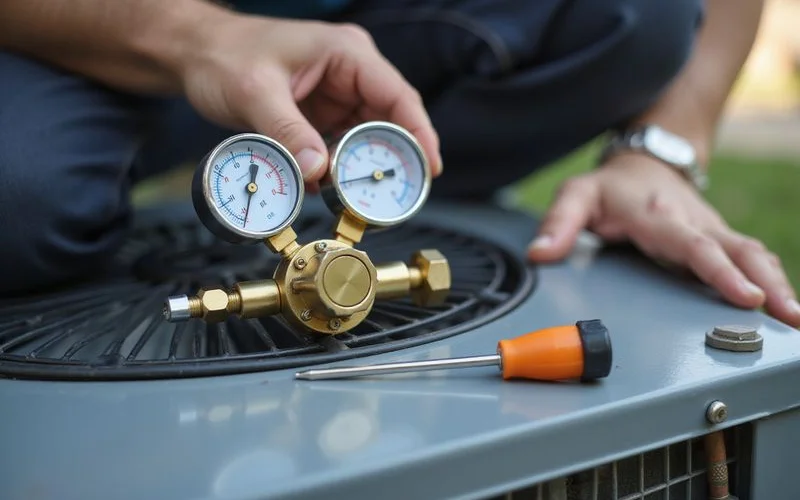
What a careful technician does
- Checks filters, coil and drain first to rule out simpler causes.
- Measures refrigerant pressure rather than guessing.
- Looks for the leak and explains where it is.
- Repairs the leak, then does a vacuum and leak test before recharging.
- Tells you the refrigerant type used and the amount added.
Our data shows that people value honest advice without upselling and clear charges. Complaints in the corpus about unexplained charges and missed diagnoses are the flip side. If a quote for gas does not say whether a leak search is included, ask. The same questions apply during routine visits, and the guide on what happens during an aircon servicing visit lists them.
Questions to ask before you pay
- Did you find the cause of the gas loss?
- What type of refrigerant does my unit use?
- Is a leak test part of the price?
- If the gas drops again, what happens?
A note on safety
Refrigerant and electrical parts can be hazardous. This is general information, not professional advice, and we recommend leaving any work on the sealed system to a qualified technician.
For how we assess the businesses in the listings, see our rubric, or head to the directory home.
Questions people ask
- Does an aircon use up its gas over time?
- A sealed system should not use up refrigerant in normal operation. If gas is low, the usual explanation is a leak, even a slow one.
- Is a gas top-up enough to fix weak cooling?
- Only if low gas is the actual cause. Dirty coils, a faulty fan or a failing component can give similar symptoms.
- How do I know a leak was actually fixed?
- Ask the technician how they located the leak, what they repaired, and whether they ran a vacuum and leak test before recharging.
- Can I top up the gas myself?
- Refrigerant work needs the right equipment and knowledge. We recommend leaving it to a qualified technician.